Together We Served has reconnected more military veterans than any other organization or website. If you served in any branch of the US military, stay connected with those you served with by joining TogetherWeServed.com.
Note From the Editor
Welcome to the spooky season, readers.
For October's Dispatches, we wanted to include something to help kick off the Halloween mood. This year, it's the story of Operation Wandering Soul, where the U.S. Army used the souls of the dead against the enemy in Vietnam.
The history of the Vietnam War is not, of course, all that spooky, but it could absolutely be scary. In Profiles in Courage, we retell the story of Marine Corps veteran Richard A. Pittman whose unit was ambushed near the DMZ in 1966. Blind in one eye and not realizing what he was running into, Pittman grabbed a machine gun and ran toward the ambush, single-handedly fighting off as many as 40 enemy soldiers.
Our book review this month is also from the Vietnam War. Ed Mann spent a year as the point man for his unit but waited 55 years to write about it. His book, "Jungle Ghosts," is an effort to exorcise the demons from the war that followed him ever since.
In Battlefield Chronicles, we revisit the 1993 Battle of Mogadishu, an action that haunts any politician or military planner who might consider a large-scale intervention in Africa. It continues to be a harsh lesson in the dangers of mission creep and underestimating one's enemy.
Finally, we talk about the Cold War-era story of Project Iceworm, the secret plan to build a complex series of tunnels and missile launchers under the Greenland ice sheet.
Is there a military legend you want us to tackle? A story you want to look into? If you have any suggestions on topics or comments on stories, send me a message at Blake.Stilwell@togetherweserved.com.
Please send all the information for Bulletin Board Posts, Reunion Announcements, and Association News to Admin@togetherweserved.com.
SSgt Blake Stilwell
USAF (2001-2007)
CONTENTS
1/ Profiles in Courage: Richard A. Pittman
2/ Check Out Your New Hi-Res Formal Military Service Plaque!
3/ Battlefield Chronicles: The Battle of Mogadishu
4/ New Veteran Buddy Link Feature - Connect With Veterans in Your Neighborhood for Friendship and Support
5/ TWS Member Comment
6/ Military Myths and Legends: Operation Wandering Soul
7/ Preserve Your Old Military Photos: Let Us Help for Free!
8/ Project Iceworm: America's Secret Cold War Nuclear Ice Fortress
9/ Do You Still Have Your Boot Camp/Basic Training Photo?
10/ TWS Member Comment
11/ Military Memories - Military Specialty
12/ Do You Still Have Your Graduation Book?
13/ Coast Guard Operations in Vietnam
14/ Have A Military Reunion Coming Soon?
15/ TWS Member Comment
16/ Send a Greeting!
17/ Book Review: Jungle Ghosts
18/ TWS Locator Service
19/ TWS Bulletin Board
Profiles in Courage: Richard A. Pittman
In the summer of 1966, American forces in South Vietnam learned that the communist People's Army of Vietnam (PAVN) had secretly slipped an entire division into the South across the Demilitarized Zone. This intelligence was backed up by numerous engagements and ambushes between PAVN forces and U.S. Marine Corps reconnaissance units.
The enemy division's mission was to capture South Vietnam's Quang Tri province. To halt the secret invasion and drive the communists back across the DMZ, the U.S. and South Vietnam launched Operation Hastings, a massive search and destroy mission with 8,000 U.S. Marines under the 3rd Marine Division and 3,000 South Vietnamese (ARVN) troops.
It was the largest and most violent combined combat operation of the war up to that point. And among the American men fighting in the jungles near the DMZ was Richard Pittman, a half-blind lance corporal who would never have made it into the Corps had he not tricked the recruiting examiner.
He would leave the Marine Corps with the Medal of Honor.
Pittman graduated from high school in 1964, but never forgot the challenge of President John F. Kennedy's inaugural address: "Ask not what your country can do for you; ask what you can do for your country." At the time, the United States was ramping up its presence in Vietnam, and the young man from California was determined to do his part.
Unfortunately, he was blind in one eye. He'd tried enlisting in the Army, Navy, Marine Corps, and Air Force, but they all turned him down, classifying him as a 4F—unfit for service. Not one to give up, Pittman heard that reserve enlistees had an easier time slipping in, so for his next attempt, he decided to sign up for the Marine Corps Reserve. It's also where he tried a literal sleight of hand.
"The final test in those days, before you went into the enlistment room, was an eye test," he said in a 2011 interview. "He told me to cover my right eye and read the chart, so I covered my right eye with my right hand and read the chart. So I did… he then said ‘Okay, now cover the other eye.' So I changed hands and covered my right eye with my left hand. And it worked."
He enlisted in the reserve on Sept. 27, 1965, where he'd also heard they would take volunteers for the regular Marine Corps, bypassing the strict medical exam that had kept him out. Sure enough, a few days later, he was discharged from the reserve and reenlisted into active duty. By the spring of 1966, Lance Cpl. Pittman was in South Vietnam, conducting search and destroy missions near the DMZ.
"We were supposed to be a blocking force," Pittman said. "Intelligence said there were eight battalions of North Vietnamese regulars crossing the DMZ in this area and, for the first time, they were coming down in force. We weren't supposed to engage the enemy at that time, we were supposed to move the enemy… our company was sent to set up a radio relay for other units. That's when we got into trouble."
On June 24, Pittman was in the rear of his column, Tail-End Charlie, when the lead end of his company was ambushed by elements of a large North Vietnamese force. He stayed in a defensive posture, like he was supposed to do… until the forward Marines began to call for help.
He and the company Corpsman started to rush to the sounds of gunfire, but along the way they ran into an M60 machine gunner standing on the trail, motionless and dead-eyed.
"You gonna use this weapon?" Pittman asked him. When he got no reply, he grabbed the weapon and some belts of ammunition and began moving to the ambush through a hail of small arms and mortar fire. What he found were too many of his fellow Marines, dead and wounded, seemingly everywhere.
Pittman fought his way forward through two automatic weapons at point-blank range, destroying both. When he learned there were more Marines wounded further up the trail, he fought his way to them, too.
There was a lull in the fighting as the enemy sent a platoon forward to check for survivors. But it was short-lived. The jungle soon exploded with gunfire as he ran into at least three dozen advancing enemy soldiers.
"Suddenly, just BOOM," he said. "I'm there and they're there. We surprised each other. It was kind of like a tie and I started shooting first."
He hunkered down in the middle of the trail and opened up with the M60. When that stopped working, he picked up a submachine gun. He burned through three weapons and his last grenade before the North Vietnamese broke and fled. He then returned to assist his wounded comrades.
Two-thirds of his company had been killed or wounded. Operation Hastings would be a success, pushing the PAVN back across the DMZ. Pittman was meritoriously promoted to sergeant and would serve in the Corps until April 1968. The next month, he received the Medal of Honor from President Lyndon B. Johnson.
He couldn't stay out of the Marine Corps for very long. By 1970, he'd reenlisted and would serve until his retirement in 1988. He died on Oct. 13, 2016 at age 71.
Check Out Your New Hi-Res Formal Military Service Plaque!
We are proud to offer our BRAND NEW, HIGH RESOLUTION PLAQUE OF YOUR MILITARY SERVICE, FREE OF CHARGE, ready to print and frame! This beautiful presentation, which will enhance any living room or den wall, incorporates the following special features:
1/ Available in your choice of 2 convenient sizes: 17" x 13.5" and 11" x 8.5".
2/ Highest resolution, 250 DPI graphics for superb presentation.
3/ Your choice of 22 military and era-related artistic backgrounds.
4/ A ‘Brief Military History’ section featuring a concise summary of your military service.
5/ Your top 3 full-sized medals plus breast and official badges.
6/ Easy upload to our low-cost, high-quality framing partner offering a 10% TWS discount.
Actual TWS Member Statement:
"This framed plaque brought tears to my eyes because it was everything I wanted and more. I will enjoy this for many years to come, and it will be passed down to my sons."
To view your Plaque – Login, and click the Blue Quick Menu Tab, then the Plaque Tab at the top left.
Battlefield Chronicles: The Battle of Mogadishu
There's not much more to be said about the 1993 Battle of Mogadishu that hasn't already been said by journalist Mark Bowden in his 1999 book "Black Hawk Down: A Story of Modern War" (or the 2001 film based on the book).
Since then, veterans of the battle like Mike Durant and Matt Eversmann have written books about their experiences. Admiral Jonathan Howe and Col. William G. Boykin have spoken publicly about it. The Army declassified its after-action material. Even the Somalis who fought in Mogadishu have told their stories.
But it's worth retelling once more because it's not only a hard lesson in the hubris of underestimating an enemy, it's a showcase of the dangers of mission creep while failing to adapt to the enemy.
In the 1980s, Somalia was rocked by civil war. The fall of Siad Barre's dictatorship in 1991 and the rise of rival rebel factions combined with a severe drought led to widespread famine in the country. Before long, even militia leaders struggled to control thousands of armed Somali fighters, who began to steal food aid by force.
In response, the UN launched UNOSOM to supply food aid and protect it with UN troops, but the 500 Pakistanis were holed up at the airport, unable to escort convoys. In December 1992, the U.S. launched Operation Restore Hope, landing more than 17,000 Marines and 10,000 U.S. Army soldiers across Somalia, which sped the famine relief. In May, UNOSOM became UNOSOM II, with the goal of reconciliation and re-establishing political and civil administrations across Somalia.
But the peace was short-lived.
In June 1993, a Pakistani force inspecting an arms cache was attacked, with 24 Pakistani soldiers killed, and more than 50 wounded. The UN passed a resolution to apprehend those responsible in the Somali National Alliance. A military manhunt for its leader, Mohamed Farah Aidid, was launched.
But when the U.S. and UN began striking SNA targets, it only fueled an insurgency that got worse as the year went on. Mogadishu became outright hostile to foreign troops. By August, President Bill Clinton deployed Task Force Ranger, consisting of Delta Force operators, a company from the 75th Ranger Regiment, Navy SEALs, Air Force Pararescuemen and combat controllers, and aviators from the Army's 160th Special Operations Aviation Regiment.
As the American force grew in size and sophistication, the Somalis showed an equal amount of resolve, using an RPG to shoot down a Black Hawk helicopter, killing three. It should have been a warning: The American intervention in Somalia began with a mission to feed the hungry and protect food aid but had drifted into counterinsurgency, nation-building, and disarmament.
On Oct. 3, 1993, the U.S. planned to capture two top Aidid Lieutenants who were meeting near the Olympic Hotel in Mogadishu, deep in Aidid territory. The initial force of 160 Americans had no idea they would be facing more than a thousand Somali fighters in an 18-hour battle.
The mission was simple. After identifying the building where the meeting was taking place, Delta Force operators would fly in on MH-6 Little Birds, secure the building and capture the targets. Four chalks of Army Rangers were to fast-rope into the street and create a defensive cordon around the four corners of the building. A column of 12 vehicles would then arrive and take both assault teams and the prisoners back to the American base. All of this would take 30 minutes.
But the enemy gets a say.
The Somalis knew they had to act fast to counter the Americans. To do this required a fast mobilization of ground forces as well as a means to take down U.S. helicopters. They would use the only advantage they had—sheer numbers—to swarm the Americans. As for the helicopters, they could be taken down with a simple hand-fired RPG.
Aidid's militia had built a warning system for exactly this. Burning tires sent up columns of smoke that told fighters across the city where the Americans had landed. Runners, radios and loudspeakers called men toward the Bakara Market. Women and children were pushed into the streets ahead of the gunmen, both as screens and as spotters.
The Little Birds landed at 1542 and all seemed to go as planned, but two critical things went wrong early for the Americans. Chalk Four, led by Staff Sgt. Matt Eversmann, was dropped roughly a block north of its assigned corner, leaving a hole in the cordon from the opening minutes.
Then a Ranger in that chalk, Pfc. Todd Blackburn, fell from a hovering Black Hawk during the fast-rope insertion and had to be evacuated by ground convoy, which pulled vehicles and men out of the plan and drew attention.
Inside the target building, the assault went the way it was drawn. Delta operators took both primary targets along with 22 others: 24 prisoners in all were flex-cuffed and waiting on the ground floor, roughly 20 minutes in. The mission had already succeeded.
The ground convoy arrived at the Olympic Hotel to wait for the Rangers and Deltas to rendezvous there. It was supposed to have been in position a few minutes after the operation began, but it was ten minutes late. As Sgt. 1st Class Jeff Struecker peeled three vehicles off to run Blackburn back to base, the convoy took the first American death of the battle, Sgt. Dominick Pilla, shot in the head while manning a weapon in an unarmored Humvee.
After some initial confusion, the Somalis took about 10 minutes to assemble. Roads near the hotel were blocked by converging fighters who were coming in from all around South Mogadishu. Ambush sites were set up along all the likely routes back to the UNOSOM base.
Then at roughly 1620, an RPG brought down Super 61, killing pilots CW3 Cliff Wolcott and CW3 Donovan Briley. Crew members Staff Sgt. Ray Dowdy and Staff Sgt. Charlie Warren were severely wounded. Delta sniper Sgt. 1st Class Daniel Busch survived the crash and held the wreck alone until help arrived, but he was mortally wounded doing it.
The search-and-rescue bird, Super 68, went in over the crash site and put 15 men down the ropes into the narrow street under heavy fire. An RPG punched into the airframe as the last man came off. The pilot, CW4 Dan Jollota, held the hover long enough to finish the insertion and then flew the crippled helicopter back to the airfield.
About 20 minutes later, Super 64 went down roughly a mile away with CW3 Michael Durant at the controls. His co-pilot, CW4 Ray Frank, and crew chiefs Staff Sgt. Bill Cleveland and Sgt. Tommy Field died at the site.
A 30-minute snatch and grab suddenly became two separate crash-site defenses in hostile urban terrain, with the ground convoy lost in the street grid, impeded by citizens and makeshift barricades, and taking heavy fire—a huge problem for them, considering they had no armor. Requests for M1s, Bradleys, and AC-130 gunships had been denied at the Secretary of Defense level.
At the Super 64 site, Master Sgt. Gary Gordon and Sgt. 1st Class Randy Shughart requested insertion three times to defend Durant and his crew, knowing no ground force could reach them. The first two requests were denied.
On the third they got the green light. Their pilot, CW3 Mike Goffena, put them into a clearing about 100 meters from the wreck. Both were killed in the fighting, while Durant was captured and would be held for 11 days. Gordon and Shughart posthumously received the Medal of Honor for their stand at the site, the first awarded since the Vietnam War.
Minutes after the insertion, an RPG tore into Goffena's Super 62, taking off Staff Sgt. Brad Hallings' leg at the minigun and forcing a crash landing at the port.
The convoy never made it to the crash site. Lt. Col. Danny McKnight's column, still carrying all 24 prisoners, spent close to an hour trying to reach Super 61 through a street grid it couldn't read, steered by radio relayed from a surveillance aircraft that was always a few seconds behind the vehicles' actual position.
The column drove past the crash site twice, doubled back through its own ambushes, and by the time it was ordered to break off and return to base it had lost most of its combat power. The prisoners rode back with it. The men at the crash site were on their own.
They could have moved, but they didn't because Cliff Wolcott's body was pinned in the crushed cockpit of Super 61, and nobody was leaving without him. The assault force pulled into two houses beside the wreck and held there through the night, cutting at the airframe with what tools they had while enemy fighters worked in close through the alleys.
The cost of having no armor and no way out came due on Cpl. Jamie Smith. Hit in the upper thigh early in the crash-site fight, his femoral artery severed. He needed surgery that no one there could perform. A medevac would have meant hovering another Black Hawk over the Bakara Market. The call was made not to risk it and Smith died in the house before morning.
The rescue column that finally assembled was a coalition improvisation: 2-14 Infantry from 10th Mountain, Pakistani M48s, and Malaysian Condor APCs moved out around 2323 and reached the Super 61 site in the early hours of the next day. Wolcott's body came free around 0530.
Only there wasn't room in the vehicles for everyone. As the column pulled out at first light on Oct. 4, the remaining Rangers and Delta operators ran out on foot beside and behind the APCs, fighting through the last few blocks to the Pakistani stadium—a run that became known as the "Mogadishu Mile."
A total of 18 Americans were killed in the fighting and 84 were wounded. The Red Cross estimated that 200 Somalis were killed and another 700 were wounded. It was the largest single action casualty count for Americans since the Vietnam War.
The sight of dead U.S. troops dragged through the streets of Mogadishu caused a public uproar in the United States, eventually ending the American presence in Somalia. The UNOSOM mission ended shortly after.
New Veteran Buddy Link Feature - Connect With Veterans in Your Neighborhood for Friendship and Support
Those who have served share a unique bond that remains with them throughout their lives. Veterans thrive in the company of other Veterans, simply because the unique culture of military service is common to all.
To provide an easy way for TWS Members to connect with other Veterans in their neighborhood, Together We Served has launched its new, free easy-to-use service called 'Veteran Buddy Link', a free, easy-to-use service specially designed to enable Veterans to seek the camaraderie of other Veterans in or around their Zip Code.
Click the button below to find a Veteran Buddy Connection near you!
TWS Member Comment
TogetherWeServed.com has helped me reconnect with and reflect on many of the experiences, people, and milestones that shaped my military career. The platform serves as a valuable reminder of the units I served with, the places I was stationed, and the Soldiers alongside whom I served. Looking through records, photographs, and shared memories often brings back experiences that might otherwise have faded with time.
Perhaps most importantly, it helps preserve the friendships and camaraderie that were such an important part of military service. Reconnecting with fellow veterans and remembering shared experiences has allowed me to maintain a connection to a significant chapter of my life. In many ways, TogetherWeServed.com helps keep those memories and relationships alive, reminding me of the people, challenges, and accomplishments that made my military service so meaningful.
Military Myths and Legends: Operation Wandering Soul
There wasn't a lot the United States wasn't willing to do to keep North Vietnam from sending troops into South Vietnam. The U.S. Air Force tried to extend the monsoon season over the Ho Chi Minh Trail by seeding the clouds over Laos. The CIA spread rumors that the U.S. would soon drop an atomic bomb on Hanoi. The Americans even used ghosts to tell the North Vietnamese they would go to hell if they didn't return home.
Well, they weren't real ghosts, but the ghost tapes made by the U.S. Army's 6th Psychological Operations Battalion probably sound convincing enough in the middle of a dark Vietnamese night.
The tapes were a part of Operation Wandering Soul, a psychological operation designed around the Vietnamese belief that a person who dies away from home and isn't returned home to receive proper burial rites is condemned to wander in torment rather than pass on.
Did it work? Maybe—there's no way to know for sure. But what's certain is that it clearly did not work on the scale the United States hoped it would.
With a little help from the Navy, the Army created a series of tapes that featured eerie, otherworldly noises like a young girl calling for her daddy to come home, Buddhist funeral music, and a man literally telling the North Vietnamese that he's burning in hell. They layered in some spooky noises, chilling music, and an echo chamber, and you've got some good old-fashioned nightmare fuel.
Tapes were played over loudspeakers mounted on helicopters flying near suspected Viet Cong positions, and also from boats and ground-mounted speakers. There was even a well-documented case where Fire Support Base Chamberlain in Hau Nghia Province used the tape against the Viet Cong hiding in the surrounding jungle.
After sweeping the surrounding jungle, the Americans captured three prisoners. Not a resounding success, but not nothing. In another instance, a tape used against a North Vietnamese-held hill forced 150 Viet Cong to withdraw.
One downside was that the sounds could actually scare the friendly South Vietnamese forces at times, too. But perhaps the biggest downside is that the North Vietnamese were as likely to shoot at wherever the sound was coming from as they were to break and run.
Preserve Your Old Military Photos: Let Us Help for Free!
Do you have old photos from your service days stashed away in a drawer or in a shoe box in your attic? Old photos fade with time and if they are not scanned and preserved digitally, they risk eventually being lost forever.
This is where TWS can help. We have just invested in a high quality Fujitsu book and photo scanner that can scan any size of photo or yearbook. As a service to our members, we would like to offer you a free photo scanning service for your most significant photos from your service which we will then return to you, in original condition, along with a CD containing your photo files.
In addition, we can upload your photos for you to your Photo Album on your TWS Service Profile which will also appear in your Shadow box and available to you to access or download at any time.
Project Iceworm: America's Secret Cold War Nuclear Ice Fortress
We all know President Donald Trump is crazy about Greenland these days, but it isn't the first time the United States thought the world's largest island was essential for its national security. During the Cold War, the U.S. planned to turn the Greenland ice sheet into a mobile, hidden ballistic missile base aimed over the pole at the Soviet Union.
There's been an American presence in Greenland since the Danish government gave the U.S. the right to build airstrips, ports, and military bases there during World War II. Dozens of bases were established during the war, but Thule Air Base (now Pituffik Space Base), built in the 1950s, is perhaps the most well-known. It became a cornerstone for U.S. missile warning and space surveillance.
In 1959, the U.S. established Camp Century about 150 miles inland from Thule. Publicized as a demonstration of affordable ice-cap construction and an Arctic research station, it was real enough—21 tunnels totaling about 9,800 feet, housing around 200 men, with sleeping quarters, labs, a barber shop, library, and hot showers, all run off a PM-2A portable nuclear reactor.
It was the first permanent base built under glacial ice anywhere. But it wasn't the real goal. The real aim was to place mobile nuclear missiles under the ice.
The Army was going to build a tunnel network threaded with rail track that could shuttle up to 600 nuclear-tipped missiles between launch points beneath the ice. The missiles were supposed to be constantly moving, so the Soviets could never target them. The planned buildout was roughly 2,500 miles of tunnels covering an area several times the size of Denmark.
The missile itself was to be an "Iceman," a shortened derivative of the Minuteman missile. The whole idea was survivability: a Soviet first strike can't kill what it can't locate.
The problem with the entire idea is that glaciers move, and how fast they move doesn't really matter. At the drilling site, the ice was moving at a faster rate than the planners had planned. Even if the Army could actually build the tunnels and the rail network, they would be closed off within two years.
As it was, the soldiers at Camp Century had to use chainsaws to keep the reactor bay open. The whole thing was just too much work and too much maintenance for an unknown return. The reactor was removed in 1964 and totally abandoned by 1967. Only two miles of tunnels were ever built.
The only traces that remain today are waste: the diesel fuel, PCBs, sewage, and low-level radiological material left behind. The only question now is who has to clean it all up.
Do You Still Have Your Boot Camp/Basic Training Photo?
Together We Served has a growing archive of more than 23,000 Boot Camp/ Basic Training Graduation Photos which we now display on your Military Service Page and Shadow Box. We also have a growing collection of Yearbooks which we will be made available on the site shortly.
We are still searching for Boot Camp/ Basic Training Photos and Yearbooks. So if you have yours available, please contact us at Admin@togetherweserved.com.
Either you can send us a scanned file of your photo or you can send it to us for scanning. We will add this for you to the Recruit/ Officer Training section of your Military Service Page.
All photos and yearbooks will be returned to you in the original condition along with a CD containing your scanned photo.
TWS Member Comment
Having gone to several military sites, most just want to sell you Stuff. TWS actually provides a service to those like myself who want to connect with the past. Our awards, accomplishments, and activities can be remembered here for others to enjoy or reminisce about. I had few friends while in the Navy, and I recognize that many made lifelong friends. I can certainly respect that and admire those who did just that. I must admit that I have already found one person I served with; thanks to TWS, I would have never found him. Now, to make contact.
Perhaps the biggest service that TWS provides is the opportunity to relive memorable events in a safe way that leaves the pain behind. Some suffered more than others; for some, suffering is gone, yet we hold onto those memories differently. TWS also provides a reality check that few, if any, provide on how we can compare our service to others. Sometimes, we don't have all our facts straight or recall events as accurately as others, and TWS provides different venues to compare.
I have found TWS to be a positive and uplifting force that allows service members to reconnect, recall memories, and transform thoughts that keep recurring throughout life into meaningful forces for good.
Military Specialty: What was your primary Occupational Specialty in the Military? What was the most significant skill you learned and was this useful in your civilian life?
Like many veterans on this site, I had several PMOSs assigned to me. In the Navy, it was Boatswain's Mate and Aviation Ordnanceman. In the Army, I was a Guided Missile Technician, Infantryman, and Infantry Instructor. I learned a lot from each of these, except the Army missile tech, which I never worked in. The Navy taught me essential military skills and something about becoming a small unit leader. 18 months supporting the war from an aircraft carrier offshore whetted my desire to become more personally involved in Vietnam. Working with ordnance that others would use in combat was not enough for me.
So, after my enlistment was up, I enlisted in the Army.
The Army was big on training. Basic Training, Infantry Advanced, leadership school, and then I was sent to be a trainer rather than a trainee. I was inexplicably given a guided missile MOS after AIT and sent to the Infantry School to become an infantry instructor. I had signed up for infantry and was demanding either to get a PMOS of infantry or a discharge. I do not believe my vociferous protestations held any sway, but after six months of paperwork, I received my PMOS change to infantry. In the interim, I had been assigned to the Weapons Subcommittee of the Weapons Committee, Company E of the Infantry School Battalion, Infantry School Brigade, where I had learned to be an enlisted instructor on the M-60 and M2 machine guns. My promotion and award of enlisted instructor as my PMOS were quick to follow. But I wasn't happy with the career path I was on anyway. I submitted a request for jump school, and it was denied. I submitted a request for a transfer to Vietnam but have heard nothing. The senior NCOs were telling me to just do my year as an instructor, go to jump school later, and get my next assignment, likely to Nam. Further, they said that this assignment was a real plum that not many people got and would look good on my record as my Army career advanced. So, I bore down and concentrated on the tasks at hand.
I did enjoy teaching the officer candidates and a few special officer classes that we taught. I loved the firing I got to do as a demonstrator/instructor, including shooting 5000 rounds in a Final Protective Fire Demonstration each Friday night. After a year of working there, I was given orders to visit Vietnam. My first assignment was to the 101st Airborne's Combat Leaders Course, then on to my assigned infantry unit. I spent about 4 months in Viet Nam before being medevaced out of the country to Japan. I returned to Nam for 2 or 3 weeks and was transferred to Fort Benning again to become a member of the 197th Infantry Brigade. I had some problems with performing some functions due to my thigh injuries and was placed on a medical profile. The last year I volunteered to attend weapons qualifications each Friday in spite of my profile, and became a TOW Guided Missile Instructor. I attended a management and leadership course, too. Near the end of my enlistment, I received a warning order that I was to return to Vietnam, but I was through with the Army and declined to go (by regulation) since I had less than 3 months left in service.
I became a civilian, unprepared for civilian life with no recognizable skills, but I really had two that would come in handy later.
The first was leadership, and that one first came into play when I worked for the USPS as a letter carrier for 9 years. I became a union shop steward and developed trust in my members and management by being honest. Everything was black and white to me. A grievance was pushed every bit I could for my members. However, management also saw that, unlike many of my peers, I would not come to them with a grievance that had no foundation.
But I burned out on the USPS and the union, So I went into law enforcement. It was not long before I was teaching firearms again, rifles and pistols. And my penchant for officer safety placed me in the Field Training Officer and investigator leadership roles. After a few years in the country (Central Texas), I worked for a suburban Houston Department. I was again placed in charge of all firearms issues. I got NRA certified as a Police shotgun and pistol instructor and expanded my instruction to an even larger suburban department. My leadership skills placed me in slots as an FTO and patrol sergeant. I received State certification as a licensed police instructor and occasionally taught a State-approved course to officers in the area.
Then I went to Harris County Sheriff's Department, the largest east of the Mississippi except for California. I refused to be involved in firearms instruction, the result of an accident in which I suffered severe gunshot wounds right after I had been hired there. I worked in the jail and the hospitals and was an informal trainer of new hires in the jail.
Later, I attended the Texas Highway Patrol Instructor course for teaching the concealed carry pistol course for civilians and instructed them on a minor scale, as I did for deputies who could not pass their firearms qualifications through the Academy's yearly instruction and were in danger of losing their commissions. That task gave me a lot of pleasure.
So, it seems that I had two significant skills that I had developed in the military.
If you would like to post your own Military Memory on why you joined the military, click HERE
Do You Still Have Your Graduation Book?
TWS is building a searchable yearbook archive that will be up and running later this year.
What's in it depends on members like you. We have invested in a high-quality Fujitsu book and photo scanner that can scan any size of photo or yearbook.
Allowing us to scan your book helps family and your brothers & sisters find a photo they may have lost along the way.
If you would like your book scanned, email us at admin@togetherweserved.com. We'll send you a flash drive with the scans when we return your book to you. You'll also receive a tracking link via Stamps.com.
Coast Guard Operations in Vietnam
By Tom Edwards
On April 29, 1965 President Lyndon B. Johnson established a 'Memorandum of the President'. That document initiated the process of the United States Coast Guard working in conjunction with the United States Navy to prevent communist troops from accessing South Vietnam. The day the Memorandum was signed, Coast Guard Squadron One (RONONE) was established. It consisted of 47 officers and 198 enlisted men. They had received their training in Coronado, California. Less than a week after the establishment of RONONE, six 82-foot U.S.C.G. cutters were in shipyards for the necessary modifications. Following the yardwork, they were transferred to the Philippines and subsequently rendezvoused with the escort ship USS Snohomish County (LST-1126). The escort enabled the required refueling given the distance from the Philippines to Vietnam. After 5 days underway, the crews rested at the South Vietnam base located at Con Son Island in the Gulf of Thailand. The following day, 3 cutters were on patrol and the other 3 were relocated to their new home port in An Thoi, a fishing village on the southern tip of Phu Quoc Island, the largest in Vietnam. It is in the Gulf of Thailand. As a USS Krishna crew member, I was stationed there for about 8 months as a Swift Boat maintenance and repair electrician. U.S.C.G. cutters arrived in An Thoi and Da Nang in July 1965. Operation Market Time then transferred from task Force 71, a Seventh Fleet organization, to Task force 15, a Military Assistance Command Vietnam organization.
The initial squadron eventually consisted of 26 cutters of the 'Point' class; shallow-water 82-foot patrol boats tasked with patrolling the South Vietnam coastal waters. During their time in Vietnam, the cutters boarded and searched approximately 250,000 junks and sampans. Additionally, they were involved in 6,000 gunfire support missions that created significant damage to enemy structures. During the course of the war, 56 cutters operated in Vietnam. Ultimately, 30 were transferred to South Vietnam. While working with the United States Navy patrol boats, the U.S.C.G. cutters had a significant impact on limiting communist infiltration of coastal waters and inland canals. Those successful operations left the enemy with one option; use the Ho Chi Minh trail as the only supply route for forces in the south. In April 1966 a Cambodian patrol in the Gulf of Thailand fired on the cutter Point Comfort. April also saw the Point Partridge capture a Viet Cong Colonel of Engineers and Coast Guard and Navy personnel coordinated to extinguish a fire in An Thoi that had destroyed a number of housing units.
In 1966, the Military Assistance Command Vietnam approved having Coast Guard buoy tenders to implement and service aids to navigation (ATON) in South Vietnam. A buoy tender was quickly on site to set petroleum buoys designed to provide needed fuel for American craft. A total of 5 buoy tenders served in Vietnam channels. They also maintained lighthouses positioned on the coast of South Vietnam. Buoy tender crew members trained Vietnamese sailors in ATON maintenance requirements. The Coast Guard constructed and provided the personnel to operate Long Range Aids to Navigation (LORN) stations. Those facilities gave sailors and pilots the ability to ascertain their locations. Operation 'Tight Reign' established LORAN sites at Con Son Island and Tan My Vietnam and Lampang, Sattahip and Udorn Thailand.
Early in 1967 the Navy requested 5 high-endurance Coast Guard cutters to coordinate with the Navy's Coastal Surveillance Forces. May of 1967 saw the cutter Barataria fire the first RONTHREE gunfire of the war. During the following February, cutters Winona and Androscoggin fired on enemy trawlers, destroying them with the support of Coast Guard and Navy patrol boats. During that combat, the cutter Minnetonka drove off another trawler. With the number of craft involved, it was among the largest naval forces engagements of the war. The Point Orient led an attack on July, 15, 1967 on an enemy trawler. The trawler sustained disabling damage, was run aground and ultimately captured.
Off shore patrol craft utilized by the Coast Guard were constructed to sustain adverse weather conditions. That was not the case for their Navy counterparts; the 50-foot Patrol Craft Fast, also known as Swift Boats that did not share the 82-foot Coast Guard cutter patrol craft design. On Leap Day 1968, 4 trawlers engaged cutters and Swift Boats south of Da Nang. 3 of the trawlers were destroyed and a fourth retreated as it headed north. The first trawler had initially attempted to penetrate the Da Nang barrier and was met with fire from the 255-foot high-endurance cutter Androscoggin. The enemy fire was quickly returned. Point Welcome closed in as Point Grey and Patrol Craft Fast used machine gun fire. The trawler fired back and was eventually beached. On March 1 shortly after 2:30 AM, the trawler self-destructed.
January 1969 saw the initial transition of Coast Guard cutters to Vietnamese control. Two Vietnamese Lieutenants reported onboard 2 of the cutters. The following month, 17 Vietnamese Navy Ensigns and 2 more Lieutenants were reported as part of the transition. Vietnamese sailors were brought in replacing their U.S. counterparts. In ceremonies held in Saigon on May 16, 1969 the cutters Point Garnet and Point League were transferred to the Vietnamese Navy. The new names were Le Phuc Dui and Le Van Nga. Simultaneously, Coast Guard cutters continued their operations. The Point Banks successfully rescued 9 friendly forces that had been trapped by the Viet Cong. The Point Cypress and Point White worked to prevent a Swift Boat from sinking. The Point White also refloated 2 Swift Boats that had gone aground in Ha Tien. Along with their numerous ongoing activities, as the number of pages on the 1969 calendar diminished, the primary goal of the Coast Guard remained the ongoing turnover as a part of what had become known as Vietnamization. On August 15, 1970, the final 2 cutters, the Point Marone and the Point Cypress were transferred to the Vietnamese. That day, Coast Guard Squadron One and Coast Guard Division Thirteen were disestablished. On January 31, 1971, Coast Guard Squadron Three was disestablished. In early February 1973, the Coast Guard Port and Waterways Detail in Vietnam was disestablished, ending that chapter of Coast Guard history in the Vietnam War.
The name 'Coast Guard', understandably, generates images of a variety of ships and boats. There were, however, Coast Guardsmen that flew in Vietnam. On April 3, 1968 U.S.C.G. piloted helicopters began coordinating Search and Rescue operations with the Air Force. Among helicopters, the Sikorsky built HH-3E, better known as the Jolly Green Giant, had 11 Coast Guard aviators. Prior to being stationed in Vietnam, their months of training involved survival techniques and the operation of a Jolly. In country they became members of flight crews frequently with Air Force copilots and engineers. The Douglas Aircraft built A-1 Skyraiders, designed during World War II for the Navy were the last tail-wheeled Navy plane. They frequently served as firepower support aircraft for the helicopters. The United States Air Force A-1's were pained camouflage, their Navy counterparts were gray and white. The initial group of Coast Guard pilots had orders that established the Coast Guard – Air Force Aviator Exchange Program.
Among the most noteworthy Coast Guard related air rescue missions began on July 1, 1968 when an F-105 Thunderbird was hit with enemy fire over the Vietnamese peninsula. The pilot, Lt. Col. Jack Modica descended too quickly as he was attempting to reach the gulf and ejected into a jungle canyon. Coast Guard Lt. Cmdr. Lonnie Mixon was the HH-3E pilot during the first rescue mission. The incoming fire he took damaged the fuel tank, electrical systems and hydraulic lines. With that level of damage, he made a second rescue attempt. Anti-aircraft fire forced him to terminate that pursuit. Mixon spent the night in the jungle. He was awarded a Silver Star for his efforts. The second day was unimaginably worse. An A-1 Skyraider was shot down, and the rescue helicopter suffered heavy damage, including an unexploded rocket inside that had penetrated the fuel tank. After multiple unsuccessful efforts, the Air Force ultimately contacted Jolly 21 pilot, United States Coast Guard Lt. Lance Eagan, and requested he fly behind a B-52 for a bomber strike. Lt. Eagan and his Air Force flight crew were quickly wheels up. After yet another extensive enemy engagement, Lt. Modica was delivered to a hospital and the crew was later decorated for the courage they had shown. The Jolly, after taking intense enemy fire during the final minutes of the rescue was heavily damaged. The fuselage had taken 40 large caliber hits, 4 of the 5 rotor blades were damaged and the fuel tank had been hit 9 times. The Jolly Green Giant was too damaged to fly and was returned to Da Nang with a heavy-lift CH 54B Skycrane helicopter. A month prior to that rescue, Coast Guard pilot Lt. Jack Rittichier was shot down while on a rescue flight. He was awarded the Silver Star, the Distinguished Flying Cross and the Purple Heart. The Coast Guard's support of combat air rescues continued for another 4 years, ending in 1972. The awards they earned included 4 Silver Star Medals, 15 Distinguished Flying Crosses and 86 Air Medals.
In more recent United States Coast Guard/Vietnam news, a report posted on Vietnam Times had “U.S. to hand over a large Coast Guard cutter to Vietnam soon.” The transfer took place on August 14, 2020. The article noted the 378-foot High Endurance cutter John Midgett, WHEC-726, would be the second Hamilton class cutter to be delivered to Vietnam, following the 2017 transfer of the Morgenthau, WHEC-722. The repainting of the Midgett that took place prior to the transfer was done in Seattle, Washington. The Phalanx CIWS, a gun based close-in system utilized to defend military watercraft, and the radar were removed. Subsequent to the dismantling of an assortment of critical equipment systems, members of the Coast Guard instructed Vietnamese sailors on the procedures necessary to navigate the ship to Vietnam. During that 2-month period, a dry dock, maintenance and repair was done at the Lake Union Shipyard in Seattle. During the dry dock work, 88 members of the Vietnam Coast Guard received training in the ship's operations. During a press conference in Hanoi, Doan Khac Viet, the vice spokesman for the Vietnamese Foreign Ministry said “The comprehensive partnership Vietnam and the United States have in recent times developed well in many fields including defense and security operations.” The Midgett was underway from Seattle on June 1, 2021, with an expected July 10 arrival date in Vietnam.
While researching the Midgett I found information that, as a fan of rock music, I thought was interesting. In 1979 the rock band Jefferson Starship (2 original members left and 3 new members joined, so they updated their name from Jefferson Airplane) used the Midgett as the site for a photo shoot for the cover of their 5th album, 'Freedom At Point Zero'. The photo was taken when the Midgett was in San Francisco, the band's home base. I enjoy live music and saw Jefferson Starship in California during their 1974 tour. When I learned the cover photo for 'Freedom At Point Zero' was taken on the Midgett, I wondered if any of the current crew members had a copy.
The United States Coast Guard motto is Semper Paratus – Always Ready. Based on what I knew about them as I was raised in New London, Connecticut, home of their Academy, and what I learned doing the research for this article, the motto is certainly appropriate. I still remember an open house the Academy had during my younger days. The 295 foot Eagle, a Barque class (sailing ship with 3 masts) used for training officers and was open to the public. As eye-catching as it is, I had to take a look. The Eagle along with the Constitution in Boston Harbor, are the only 2 active sailing ships in the military.
During the United States Coast Guard Oral History Interviews and Memoir Project, Captain Donald M. Taub, U.S.C.G. (Ret.) Academy class of 1956, recalled some of his experiences in Vietnam. In 1968 he reported to the SPENCER (WHEC-36) as the Engineering Officer. The SPENCER arrived in Vietnam on February 11, 1968, and departed on September 30, 1969. Taub served as a SPENCER crew member during its deployment to Squadron Three in 1969 in Vietnam. He noted “We ended up getting the Presidential Unit Citation early on. The policy had recently changed in Vietnam with President Nixon's election. The new policy was 'Vietnamization'. Most of our early operations were along the coast of the Mekong Delta and up the coast. This was in conjunction with Boat Division 11's joint United States Coast Guard – United States Navy Command Center based in An Thoi on Phu Quoc Island near the Cambodian border. Besides naval gun support we also acted as the 'mother ship' for a group of Navy Swift Boats. The SPENCER was outfitted differently. A World War II magazine was converted to a fuel tank for the Swift Boats and the balloon shack became a bunk room for the Swift Boat crews. We also carried Cambodian mercenaries who were led by U.S. Army Special Forces personnel. They were part of the CIA's 'Phoenix Program' and were often transported on Swift Boats. We did maintenance on their boats. Fed them. Gave them a place to sleep. Refueled their boats. Resupplied their ammunition. They tied up along us.” After completing his tour of duty in Vietnam, Captain Taub returned to New York on the SPENCER. He was reassigned to OCMI (Officer in Charge, Marine Inspections) New York in Battery Park on the southern tip of Manhattan. A new shipyard was starting up, Sea Train, which had taken over the Brooklyn Navy Yard.
Another Coast Guard veteran that took part in the United States Coast Guard Oral History Interviews and Memoir Project is Larry Villarreal. Inducted in 1965 at the Coast Guard station in West Long Beach, California, from there it was on to San Francisco for basic training. Underway again, he was on to Engineman School in Groton, Connecticut. Having completed that training from Travis Air Force base, he flew to Saigon, arriving a few days after the 1968 Tet Offensive. He was initially stationed in An Thoi on an 82-foot cutter. Larry said: “My first job was on board a repair ship anchored just off An Thoi. We lived on base and worked there repairing mechanical systems for the 82's, engines and generators, pumps, hydraulics. Describing life on an 82-foot cutter, Larry said: “We lived on board. The crew from First Class on down lived in the forward section. I believe there were six of us there.” He added “We had pretty good chow. We drank a lot of Kool-Aid, too.” The interviewer asked, “I want to talk about the missions of the 82's. What was you all's typical mission?” Larry replied. “At the time, the duty was to patrol the coast and, I believe we had a limit of one mile out, but I don't think we ever got that far. And our purpose was to stop vessels that we came across for inspection and to see if they were carrying contraband or people without proper ID.” Larry was asked about his one year tour in Vietnam was coming to a close, leaving the base and going back to Saigon. That was in the February/March 1969 time frame. He was also asked if he remembered flying from Vietnam back to California and replied, “Yes. We came back the northern route and then came back to the base in the Bay Area.” Larry informed the Coast Guard he was not going to reenlist, “So they mustered me out in Long Beach.” After his service in Vietnam, Larry worked for the Case Dealership in Riverside, California. Near the end of the interview, Larry said “Retired now. Highly recommend it.”
Like the Coast Guard Academy, The Day is an award-winning newspaper that is also headquartered in New London, Connecticut. The November 7, 2015, edition had “Coast Guard Vietnam veterans share wartime stories at Coast Guard Academy.” William Carr was among those veterans. He said, “Quite frankly, I haven't talked about any of this for 48 years.” He had served as a Commanding Officer on two Point class cutters. The article noted, “Carr was inducted into the academy's Hall of Heroes and to prepare for the ceremony, he retyped his debriefings that detailed all the patrols he went on during the year he was in Vietnam. Carr, along with retired Captain Ernie Cummings, a 1963 academy graduate who served as the Commander of the Eagle, and Jim Loomis, a 1965 Officer's Candidate School graduate, shared stories of their wartime service in a program commemorating Veteran's Day. Loomis participated in the Coast Guard/Air Force pilot exchange program and served as a HH-3E Rescue Crew commander during the war.” He said, “Our job was primarily to recover downed air crews throughout Southeast Asia” and added his unit “had a very successful rate of picking up surviving crew members.” The article pointed out “All the men worked with other military services and various agencies. Cummings, who was Commanding Officer of the Point Grace during the war, in particular worked with the newly established SEAL Team One at the time. The Point Grace would drop off SEAL Team One just after sunset in the Rung Sat Secret Zone just south of Saigon, Cummings explained where they would go in and do whatever they were doing and then pick them up an hour before sunrise.” “We did what we knew best to do, which was firefighting, search and rescue, and it was really basically Coast Guard duty but with the overlay of combat.”
Have A Military Reunion Coming Soon?
TWS has nearly 2 million members who served in a wide range of units, ships, squadrons and duty stations. Get more people to your Reunion by sending your Reunion information to us in the following format and we will post it for free in our Reunion Announcements on Together We Served, in emails that go to our members and in our Newsletters.
Service Branch Reunion Applies To:
Your Reunion Name:
Associated Unit or Association:
Date Starting:
Date Finishing:
Place Where Held:
City:
State:
Contact Person:
Contact Phone Number:
Contact Email Address:
Website:
Other Comments:
TWS Member Comment
TogetherWeServed has given me a reason to go back through 25 years of Coast Guard memories that I probably would not have revisited otherwise. While building my profile, I found myself looking through old photographs, newspaper articles, certificates, awards, and other memorabilia that I had saved over the years.
Seeing those things again brought back memories of individual assignments, cutters, operations, places I visited, and people I served with—some of which I hadn't thought about in decades. One photograph or old newspaper clipping can bring back an entire story that had almost been forgotten.
Putting my assignments in chronological order also made me appreciate the progression of my career—from a young Seaman at Station Galveston, to Electronics Technician, Chief Petty Officer, and eventually Warrant Officer. It reminded me just how many different experiences and people were part of those 25 years.
TogetherWeServed has become more than just a record of where I served. It has given me a place to preserve those memories and stories for my family, and hopefully reconnect with some of the people who were part of them.
Send a quick Greeting Card to another TWS Buddy or New Member by clicking on the blue "Send a Greeting" button on their Profile Page.
A Range of Different Cards are available.
Book Review: Jungle Ghosts
Walking Point in Vietnam
By Ed Mann
The man out front sees everything first. He's also the one who dies first. Walking point was among the deadliest jobs of the Vietnam War, and most soldiers took their turn and were glad when it ended.
Mann took it and kept it for a full year, and then waited 55 years to write about it. "Jungle Ghosts: Walking Point in Vietnam" is the result of that work.
It's the author's retelling of his tour with the 1st Cavalry Division from June 1969 to June 1970. He isn't writing about a job he endured, he's exorcising demons that he endured ever since. The job itself, well, at times it feels like he loved it.
Mann was 20 when he stepped under a jungle canopy for the first time, a junior enlisted man with a chip on his shoulder and, by his own account, almost little respect for authority for authority's sake. He was fighting a war he didn't believe in against an enemy he didn't hate. Both things are true at once, and his book makes no attempt at reconciling these contradictions.
"I was repulsed by the senselessness and savagery of the war, and I was saddened by the price it exacted," he writes, "but I was seduced by it too; proud to be performing an important role in a deadly fight for survival and lured by the adrenaline rushes."
Early in his tour, Mann's squad took cover in a bomb crater, and he understood immediately that staying there meant dying there. He pushed the squad to the treeline. Minutes later, North Vietnamese mortars worked the empty crater over.
Not long after, he missed a bunker complex entirely and hit the dirt with his head a couple feet from an abandoned gun port. He learned from it, including the tactical detail that the NVA routinely gave up clean fields of fire in exchange for better camouflage, a trade that made their positions nearly invisible from the front.
But the crux of "Jungle Ghosts" is a decision Mann made in his first days in country and never revisited: that to survive, he'd trust his own judgment regardless of who was giving orders.
He disobeyed orders he considered fatal. He criticized superiors, and he got a few incompetent ones moved out. His reputation as the man who could read the jungle bought him that latitude. He was an enlisted man's enlisted man: he loved his comrades in arms and admired the magnificence of the jungle. His disrespect for the planners in Washington is as evident as his distaste for the men in the rear echelon.
Mann meant for the book to be a cathartic writing experience and it shows. But not once does he lecture the reader on the merits of the war, he simply states what happened and lets the reader draw the conclusion.
"This is not a story of a hero, but of a survivor."
Available for Together We Served members only! Together We Served has two hard-working Marines devoting their time and energy to help our members find long-lost friends who are not yet members of our Together We Served.
If you are looking for someone, email us at admin@togetherweserved.com with name, approximate age, where they were from, last known address, marital status, and name of spouse. We'll do our best!
TWS Bulletin Board
If you wish to make a post to our new Bulletin Board - People Sought, Assistance Needed, Jobs Available in Your Company, Reunions Pending, Items for Sale or Wanted, Services Available or Wanted, Product or Service Recommendations, Discounts for Vets, Announcements, Death Notices - email it to us at admin@togetherweserved.com.
Service Reflections Video of the Month
#TributetoaVeteran - MSgt Jack Jobes US Air Force (Ret) 1964-1988
Are You a Writer?
As you know, Together We Served is always looking for interesting articles to post to our forums and in this newsletter. Have you written any military-related articles you want to share with a broader audience? Send your submissions to admin@togetherweserved.com, and you may see them in an upcoming issue.
TWS Flyers Available
Do you have a reunion coming up and would like to spread the word about Together We Served? We now have flyers that help explain who we are and what we do.
Send your requests to admin@togetherweserved.com. Please include your name, address, and the number of flyers you require.
TWS Invite Cards
Did you know we have Together We Served invite cards you can hand out to any veteran you meet? We have included a handy QR code on the back of the card so prospects can scan it right away to get started.
If you would like some cards, email us your name and address at admin@togetherweserved.com, and we will send them to you.
Do You Work at a VA?
As you may know, TWS has been working with the VA to help our veterans who may be isolated find local veterans for companionship and camaraderie. We also provide a way for them to display their military history to family and friends, and to find those they may have served with for a buddy statement.
TWS has developed several handouts that can be displayed and given to any veteran you believe would benefit from TWS's services. We have a small poster, a brochure, and business cards. We will provide you with the display holders.
If you would like any of these materials, please email me directly at diane.short@togetherweserved.com, and I will be happy to mail them to you.
Your Invite QR Code is now available to download to your phone and share with the veterans you may meet. Scanning this QR code will give you credit for their membership. You receive 6 months of full membership for every 5 people who join through your invite. If 50 people join, you'll receive a lifetime membership!
Military News
Over 30,000 Veterans' Medical Results, Personal Information Exposed by Cyber Data Breach
By Katherine Plummer, Military Times
Over 30,000 veterans' sensitive health data was compromised after a cybersecurity breach took place at a genetic testing laboratory.
News outlet FedScoop, citing an email a Department of Veterans Affairs (VA) official sent to congressional staff on Monday, reported that a cybersecurity incident at the company Baylor Genetics around June 15 led to the information leak.
The outlet said this led to an unauthorized third party accessing names, dates of birth, medical testing information, lab test results, health insurance date and partial Social Security numbers.
Military.com verified the email and its contents after reaching out to the VA.
"Upon learning of the incident, VA took immediate actions to ensure that affected veterans are protected, by evaluating Baylor's notification process and compliance with its contractual and security responsibilities," the email said.
Baylor "immediately secured our systems, engaged leading independent cybersecurity and forensic specialists, notified law enforcement, and implemented additional security measures," a Baylor Genetics spokesperson told FedScoop.
"There was no impact on our ability to provide genetic testing services," they added.
How Many Veterans Were Affected
The email said that 30,263 veterans were affected in total, and 29,483 will receive mailed notices about the incident.
This mailed notice will "advise affected veterans to review account statements, explanation-of-benefits statements, and credit reports for unusual activity; enroll in the complimentary credit-monitoring and identity-protection services; and consider additional safeguards such as fraud alerts and credit freezes," the email said.
It added that Baylor reported it was not aware of the theft or misuse of personal information related to the incident.
"VA worked with Baylor to improve the notification process and revised Baylor's Interconnection Security Agreement to address delays in Baylor's sharing of breach-related information with VA," the email reportedly added.
"We are pleased to say that our systems are operational, our environment is secure, and our important work with all stakeholders continues as usual. We have also notified potentially impacted patients and employees about the event, along with regulators," Baylor officials said.
Recent Incidents and Cuts to Cybersecurity
It is not the first time data breaches have affected veterans and active service members.
In May, Military.com reported that over 70,000 U.S. Army files with sensitive information about military personnel were leaked.
Leaked information also included maintenance work orders, building schematics, personally identifiable information of military personnel, and personally identifiable information of contractors.
At a macro level, government departments have recently made cuts to cybersecurity programs. Units tracking cyber threats in the Office of the Department of National Intelligence were cut in August 2025 as part of plans to cut staff at the agency by almost 50%. Among the cuts were units that track cyber threats.
The Department of Defense (DOD) suspended a cybersecurity compliance plan in July, citing concerns about the cost and bureaucracy involved in implementing it.
The new plan would have forced companies to pass a cybersecurity assessment from a certified third party before receiving contract awards from DOD.
Pentagon Investigating How F-35 Fighter Jet Parts Bound for US Were Diverted to Hong Kong
By Derricke Dennis, Military.com
Lawmakers on Capitol Hill have launched an inquiry into reports that sensitive F-35 fighter jet technology was somehow sent to Hong Kong this summer in an unexplained mishap.
Politico was the first to report how the shipment of F-35 parts was bound for the United States for repairs but was rerouted over the Pacific Ocean from Australia. The incident has raised concern over the possibility that Hong Kong, a special administrative region of China which has become an increasing U.S. adversary, could have access to key components of the highly classified weapons system.
The report claims an intermediary was transporting the parts on behalf of manufacturer Lockheed Martin. It's not clear why the equipment was rerouted to Hong Kong or who has possession of it now.
Military.com reached out to the Pentagon's F-35 Joint Program Office for further details of the diverted F-35 parts, asking specifically how it could happen and whether national security could be at risk by having sensitive military jet components in the hands of China.
"The F-35 Joint Program Office and Office of the Secretary of War are aware of a shipment issue of unserviceable F-35 Lightning II components," the office told Military.com. "We are actively working with U.S. authorities and industry partners to retrieve these components, investigate the incident, and place safeguards to avoid a future occurrence."
Lockheed said in a statement: "Our teams handle every shipment with the utmost diligence and safeguards to ensure the integrity of the F-35 program and the security of our allied partners."
What Was in the Shipment?
The shipment reportedly included one of the jet's cockpit canopies, which contains stealth technology that only the U.S. and its allies can access.
It's an acrylic bubble that tops the cockpit and is coated with a thin layer of transparent radar absorbent material that helps hide the plane from enemy radar.
The incident has led to a series of inquiries and briefings among congressional lawmakers and staff serving on key national security committees. Many are concerned an adversary could study the parts and potentially copy or reverse-engineer the technology for their own use.
Politico reported that U.S. State Department and Pentagon officials were first briefed staff in June, according to sources, and that additional briefings are expected in coming weeks.
The shipment's unexpected diversion to Hong Kong would have brought it under Beijing's command, which has in recent years kept a tight hold on Hong Kong. There are strict national security laws that allow Chinese authorities to influence Hong Kong's political system and crack down on dissent.
Complicated F-35 Supply Chain Protocols
Politico reported the diversion could be related, in part, to the F-35's vast and complex supply chain that relies on facilities across multiple countries to transport and repair parts.
According to an Air Force description, the canopy's thin layer of stealth protection can degrade over time, prompting a process of repair or replacement parts for the more than 1,300 fighter jets produced for the U.S. and its allies.
Australia operates a number of maintenance depots for the jet, but none are capable of repairing canopies. F-35 manufacturer Lockheed Martin manages the program's overall supply chain and uses commercial shipping providers to transport parts.
The F-35 program, which includes the U.S. and other nations including the U.K., Australia, Denmark, Norway and Poland, has an unprecedented way of managing aircraft parts. Countries have access to a shared pool of spare parts that are stored around the world.
Although the Department of Defense has stepped up oversight of the F-35 supply chain in recent years, Lockheed actually accounts for the spare parts in the pool. In a Government Accountability Office report from 2023, more than 1 million F-35 spare parts were found to have gone missing in the past five years.
"The F-35 Joint Program Office does not track or enter these spare parts into an accountable property system of record that would enable it to capture and store real-time changes to property records," the report said. "The prime contractors maintain this information."
The F-35 fighter jet program is on track to be the world's costliest, with the Pentagon expected to spend almost $2 trillion over the course of the program's lifespan.
Army and Navy Reservists Accuse Government of Withholding Pay Owed to Federal Employees
By Adam Gramegna, Military.com
Five Army and Navy reservists who also work as federal civilian employees have accused the U.S. government of failing to pay them wages they say they are owed, filing a legal complaint that seeks to recover compensation withheld despite a 2025 Supreme Court ruling in reservists' favor.
The five current and former employees of the Defense Department, Justice Department and Department of Veterans Affairs are reservists , Shea Matthew Gibbons, Lacy Jaudon, Bryce Miller, John Mezzanotte and Shahara Timbrook.
The complaint, Jaudon v. Department of Defense, was filed Sept. 23 with the Merit Systems Protection Board, an independent agency that hears federal employees' workplace disputes.
They are seeking what is known as reservist differential pay. Their complaint asks to be treated as a class covering others in the same position, according to Bloomberg Law and Stars and Stripes, which reviewed the filing.
What is Differential Pay?
Differential pay addresses a gap that can open when a federal civilian employee is called to active military duty.
If the employee's military pay is lower than the civilian salary, the government generally must make up the difference so the employee does not lose income for serving. That guidance is provided under a law Congress passed in March 2009 called the reservist differential pay statute.
It is not a bonus or a second paycheck; rather, it covers the shortfall between the two rates. The reservists say their agencies did not pay it.
According to reports, Mezzanotte, an assistant U.S. attorney, served on active duty and had his request for the pay denied in August, while the others claim they went without the differential during qualifying periods of service stretching back years.
Supreme Court's Ruling
The complaint builds on a 5-4 split decision on April 30, 2025, in Feliciano v. Department of Transportation.
The Court ruled that federal employees called to active duty during a national emergency are entitled to differential pay, rejecting the government's narrower argument that a reservist had to prove a substantive connection between the service and a specific emergency.
That case involved Nick Feliciano, an air traffic controller with the Federal Aviation Administration, and a Coast Guard reservist who was denied pay.
Writing for the majority, SCOTUS Justice Neil Gorsuch said the service and the national emergency need only overlap in time. The court noted that tens of thousands of federal civilian employees serve as reservists.
"The Supreme Court could not have been clearer: these men and women earned this pay, and the law requires the government to make them whole," said Andrew Tutt of Trial Lawyers for Justice, who represents the reservists.
A Guidance Gripe
More than a year after that ruling, the Office of Personnel Management's public guidance still reflects the interpretation the court rejected.
The agency's website currently states that qualifying active duty does not include voluntary active duty under a provision of law known as Section 12301(d). This is the same category of service at issue in the Feliciano case.
Section 5538 directs OPM, in consultation with the Defense Department, to write the regulations needed to carry it out. That guidance has not been updated to reflect the ruling.
In August, Army reservist and VA attorney Marcus Colicelli filed a separate lawsuit seeking to force OPM to issue new regulations. Federal News Network reported that 15 months after the decision, the guidance remained unchanged.
The Office of Personnel Management did not respond to a request for comment from Military.com on why its guidance still reflects the earlier interpretation, or when it would be updated.
Reservists Chose The Forum
This complaint is not the only case pushing the issue.
In Platero v. United States, the U.S. Court of Federal Claims certified a class in March covering reservists denied differential pay, but a six-year statute of limitations has limited that case to claims dating to May 2019.
The reservists argue that the Merit Systems Protection Board can reach further back.
Their complaint contends that because it is brought under the Uniformed Services Employment and Reemployment Rights Act, which they say carries no filing deadline, the board can address unpaid compensation dating to the differential-pay law's creation in 2009.
Whether the board accepts that argument remains undecided.
The board has a set period to decide whether to hear the matter as a class. Tutt has said the named reservists are likely owed a few thousand dollars each, though there is no public estimate of how much the government might owe in total.
Trump Ordered a Major Change to Veterans Benefits
By Douglas Lindsay, Military.com
For most of his Air Force career, retired Lt. Gen. Brian Kelly thought about how to get the right people into uniform, develop them and keep them there.
Increasingly, Kelly sees those as parts of the same continuum.
And for Kelly, taking care of those people shouldn't suddenly become more complicated when they take off the uniform.
His vision is straightforward: When a service member becomes a veteran, the federal government should already know who that person is, have access to the records documenting that service and be prepared to help connect the new veteran with the benefits he or she may have earned.
Instead of forcing veterans to figure out a new system on their own, Kelly believes technology and greater cooperation between the Defense Department and Department of Veterans Affairs could eventually allow the government to come to them.
And a new executive order suggests that system may be getting closer.
Making the Handoff Seamless
President Donald Trump signed an executive order Sept. 8 directing the Defense Department and VA to overhaul how military personnel and medical records are shared between the departments.
The order requires the departments within 180 days to establish updated technology and policies allowing the permanent and ongoing sharing of Official Military Personnel Files and Service Treatment Records from the time someone enters military service through the period when that person requires VA benefits.
It also calls for new digital tools, including artificial intelligence and other emerging technology, aimed at creating a single source to help veterans apply for and access benefits and employment opportunities.
VA Secretary Doug Collins said the changes could eliminate weeks of waiting for veterans applying for health care and financial benefits. The VA estimates improved records sharing could cut another 20 to 30 days from processing times for recently separated service members.
That goal closely resembles the future Kelly described to Military.com.
Kelly said a transitioning service member should eventually be able to reach the VA and hear, essentially: The government already has your information. It knows what benefits you may be eligible for. It knows what medical conditions are documented. Now, what else do you need?
"You are now in the VA system," Kelly said, describing what that future interaction might look like.
The larger change, he said, would be making the government more proactive rather than requiring veterans to initiate every part of the process themselves.
"For the VA to get that automatically picked up and be proactive with [the veteran], and not reactive to [the veteran], would be a game changer for the veteran community," Kelly said.
More Than Disability Claims
Much of the public discussion surrounding veterans benefits focuses on disability compensation and the claims process. Kelly said the opportunity is broader.
"Claims are, and people focus on the claim piece, but there are lots of other aspects of VA and veteran benefits," Kelly said, pointing to housing, education and other benefits earned through military service.
The Sept. 8 order takes a similarly broad approach.
In addition to improving the flow of records between the military and VA, it directs changes to the Transition Assistance Program and other workforce programs.
The goal is to connect departing service members with specific job opportunities, training or apprenticeships before separation and link them with government veterans representatives who can assist with applications for health care, disability, home loan, education and other benefits.
MOAA has publicly welcomed the effort, saying it plans to work with VA and other stakeholders on improving the Pentagon-to-VA records handoff and expanding transition and career support.
For Kelly, the issue isn't about assigning blame for a system that has developed over decades.
He noted that the Defense Department and VA are separate federal departments with different missions, structures and measures of success. The opportunity, he said, is to align those systems more closely around the person moving between them.
Senate Blocks Report on Nine Americans Killed in the West Bank
By Haley Fuller, Military.com
The U.S. Senate blocked a measure Sept. 29 that would have required the State Department to account for the deaths of nine Americans in the West Bank.
The 47-51 procedural vote stopped a resolution seeking information about killings attributed to Israeli security forces or settlers. Senators declined to advance a mandatory accounting of American deaths involving a country receiving U.S. security assistance.
The division fell almost entirely along party lines. Every Republican who voted opposed advancing the measure, except Sen. Rand Paul of Kentucky. Every Democrat who voted supported it, except Sen. John Fetterman of Pennsylvania. Both independent senators—Bernie Sanders of Vermont, and Angus King of Maine, who caucus with Democrats—supported it.
The resolution's sponsors, led by Sens. Chris Van Hollen (D-Md.), Tim Kaine (D-Va.) and Sanders, sought information about killings attributed to Israeli security forces or settlers. They said neither the Israeli nor the American government secured justice for the nine citizens.
The proposal would have required the Trump administration to explain what it knew about their deaths and what had been done to hold those responsible accountable.
The Americans Behind the Vote
The resolution identifies Omar Assad, Shireen Abu Akleh, Tawfic Abdel Jabbar, Mohammad Khdour, Aysenur Ezgi Eygi, Amer Rabee, Sayfollah Kamel Musallet, Khamis Ayyad and Nasrallah Abu Siyam.
The resolution's list covers West Bank deaths since January 2022. It excludes Americans killed elsewhere, including World Central Kitchen worker Jacob Flickinger in Gaza in April 2024.
The human rights organization DAWN maintains a broader historical list of Americans killed by Israeli forces or settlers since 2003.
Assad was an elderly Palestinian American detained by Israeli soldiers in January 2022. Soldiers bound, blindfolded and gagged him. He was found dead afterward.
His death became part of a dispute over whether the Israeli battalion Netzah Yehuda should remain eligible for American assistance under human rights restrictions. A detailed accountability examination describes how U.S. officials considered withholding assistance and ultimately did not impose that restriction.
Abu Akleh, a Palestinian-American journalist, died while covering an Israeli operation in May 2022 in Jenin. The U.S. assessment concluded that gunfire from Israeli military positions likely killed her, while finding no reason to believe the shooting was intentional.
Ballistic analyses could not definitively identify the bullet's origin because it was badly damaged. Those findings illustrate why responsibility, intent and criminal accountability require separate examination.
Several victims were teenagers. The resolution describes Tawfic Abdel Jabbar and Mohammad Khdour as 17-year-olds killed in separate shootings in 2024, and Amer Rabee as a 14-year-old from New Jersey killed by Israeli security forces in April 2025. The resolution presents these accounts as allegations requiring scrutiny.
Aysenur Ezgi Eygi, a 26-year-old American raised in Seattle, died in September 2024. Israel's military said its troops likely killed her through unintentional gunfire. Then-Secretary of State Antony Blinken called her killing "unprovoked and unjustified".
Sayfollah Kamel Musallet, 20, was visiting family when settlers beat him to death in July 2025. His father demanded American action. U.S. Ambassador to Israel Mike Huckabee called the killing a "criminal and terrorist act" and demanded accountability.
Khamis Ayyad, a 40-year-old Palestinian American and father of five, died of smoke inhalation in August 2025 after settlers set homes and vehicles ablaze during an attack on Silwad, according to the resolution's account.
Nasrallah Abu Siyam, a 19-year-old American born in Philadelphia, was shot and killed in February 2026 during a settler attack on Palestinian farmers in Mukhmas, near Ramallah.
His death prompted 31 senators to demand an investigation and accountability from the Trump administration. Their letter said none of the nine killings had resulted in accountability from the Israeli government.
A US Veteran Killed in Gaza
Jacob Flickinger, 33, an American-Canadian citizen and Canadian Army veteran, was among seven World Central Kitchen workers killed by Israeli airstrikes in Gaza on April 1, 2024. He left behind a partner and young son.
The organization's tribute to Flickinger describes a disciplined aid worker whose military experience helped him solve problems in chaotic conditions.
Flickinger was not listed among the nine West Bank victims covered by the resolution.
Israel's initial military investigation attributed the strikes to mistaken identification, decision-making errors and violations of operating procedures. It announced the removal of two officers from their positions and reprimands for senior commanders.
Congress Had a Tool with Consequences
The blocked resolution invoked Section 502B(c), an existing mechanism allowing either congressional chamber to require a State Department statement about a security assistance recipient's human rights practices within 30 days.
Failure to deliver the statement would halt covered security assistance until submission, unless otherwise specifically authorized by law.
Once a statement arrived, Congress could consider a joint resolution restricting, terminating or continuing assistance. Advancing the reporting measure would not itself have convicted anyone or immediately ended military aid.
The mechanism carries genuine consequences. Opponents could reasonably scrutinize its scope and potential effects on assistance.
But the statute also expressly invites the Secretary of State to explain extraordinary circumstances and national interests supporting continued aid. Congress had a way to simultaneously examine American deaths and the case for maintaining support.
The separate Leahy laws restrict assistance to foreign security units implicated by credible information in gross human rights violations, subject to applicable exceptions. Such scrutiny already forms part of security assistance policy.
An Alliance Does Not Answer for American Deaths
Outgoing Sen. Steve Daines (R-Mont.) urged colleagues to oppose the measure and "stand with our ally Israel" against Iranian-backed terrorism.
Daines framed scrutiny of American deaths as a threat to supporting Israel. In his own statement, he said he was "confident this administration will get to the bottom of this issue" while urging senators to reject a requirement that it document its findings.
That position asks Congress to accept confidence in the administration as a substitute for oversight, and families to accept another assurance without an enforceable deadline for answers.
The resolution carried potential consequences for military assistance, but it also allowed the administration to explain why continued support serves American interests.
Senators could support Israel's defense and still demand an accounting of American deaths.
Blocking the report did nothing to resolve the tension between supporting Israel and securing accountability for American deaths. It simply removed a requirement to explain how the administration was handling it.
Did You Serve at Lajes Field? Come Back to Terceira.
For thousands of U.S. service members and their families, Terceira was once a place they called home. Maybe you remember arriving at Lajes Field for the first time, exploring the island, discovering its traditions, making friendships with the local community - or simply the everyday moments that became lasting memories. For some, children were born here. For others, Terceira was where friendships and experiences began that have stayed with them for decades.
We would love to welcome you back. Come and see the places you remember, discover how the island has changed and how much of its character remains the same. Bring your spouse, children or grandchildren and show them the Terceira that became part of your own story. And even if a return is not yet in your plans, we would love to hear your memories of Lajes and life on the island.
Today, Terceira is closer than you may think, with connections from the United States including Boston with Azores Airlines, Newark with United Airlines, and options from San Francisco with TAP Air Portugal. If you served at Lajes or lived on Terceira, tell us your story or let us help you rediscover the island: geral@exploreazoresislands.com. You can also explore what awaits you at Explore Terceira Island.
Some places stay with us long after we leave. Perhaps it’s time to come back to Terceira.
8th and 9th Air Forces in WWII
I am currently researching the impact that members of the 8th and 9th Air Forces had on the town and surrounding villages of Saffron Walden and Cambridge during the Second World War. Rather than concentrate on specific missions or aircraft or pilots I am looking at the interaction between 'The Yanks' and 'The Limeys' between 1942 and 1945. I already have a couple of terrific stories that involve servicemen involved in an incident on 27th May 1944 in Ashdon, Essex where a local farmers wife died trying to save aircrew of a crashed 'Havoc' Bomber. I have tracked down one person, Pfc James Pasternak through an Obituary site but am still trying to establish the fate of three others who survived or were involved in the incident. My intention is to produce a number of short stories/vignettes of events in our local area that I can present to my grandchildren and hopefully publish given the right circumstances.


 The enemy division's mission was to capture South Vietnam's Quang Tri province. To halt the secret invasion and drive the communists back across the DMZ, the U.S. and South Vietnam launched Operation Hastings, a massive search and destroy mission with 8,000 U.S. Marines under the 3rd Marine Division and 3,000 South Vietnamese (ARVN) troops.
 "The final test in those days, before you went into the enlistment room, was an eye test," he said in a 2011 interview. "He told me to cover my right eye and read the chart, so I covered my right eye with my right hand and read the chart. So I did… he then said ‘Okay, now cover the other eye.' So I changed hands and covered my right eye with my left hand. And it worked."
 He and the company Corpsman started to rush to the sounds of gunfire, but along the way they ran into an M60 machine gunner standing on the trail, motionless and dead-eyed.
 He hunkered down in the middle of the trail and opened up with the M60. When that stopped working, he picked up a submachine gun. He burned through three weapons and his last grenade before the North Vietnamese broke and fled. He then returned to assist his wounded comrades.

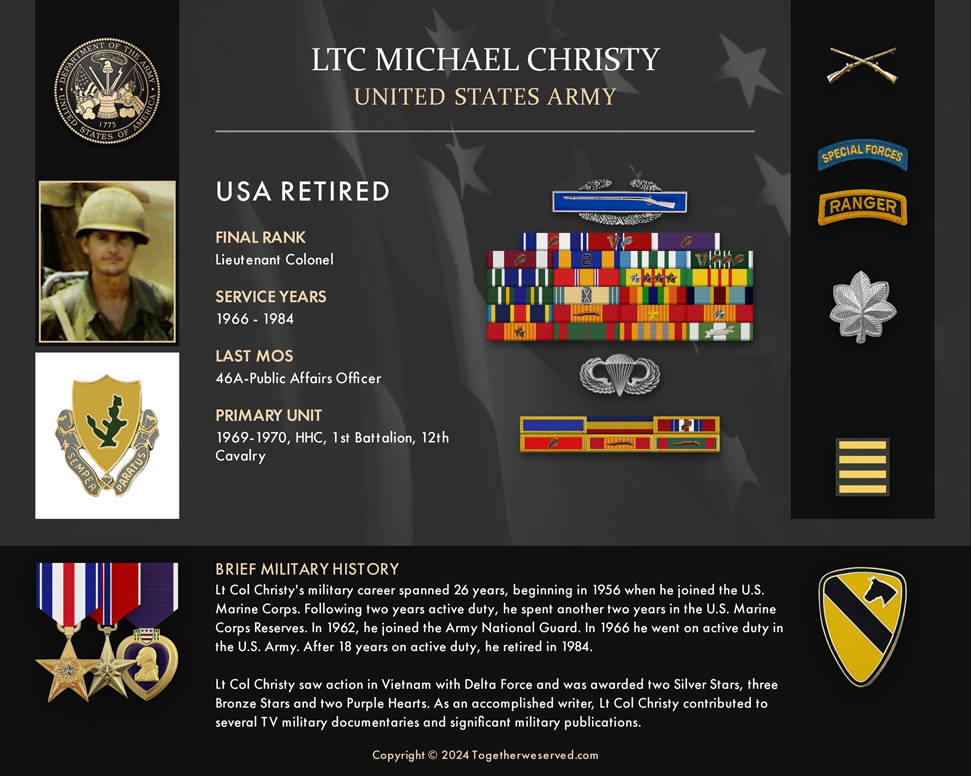

 Since then, veterans of the battle like Mike Durant and Matt Eversmann have written books about their experiences. Admiral Jonathan Howe and Col. William G. Boykin have spoken publicly about it. The Army declassified its after-action material. Even the Somalis who fought in Mogadishu have told their stories.
 In June 1993, a Pakistani force inspecting an arms cache was attacked, with 24 Pakistani soldiers killed, and more than 50 wounded. The UN passed a resolution to apprehend those responsible in the Somali National Alliance. A military manhunt for its leader, Mohamed Farah Aidid, was launched.
 The mission was simple. After identifying the building where the meeting was taking place, Delta Force operators would fly in on MH-6 Little Birds, secure the building and capture the targets. Four chalks of Army Rangers were to fast-rope into the street and create a defensive cordon around the four corners of the building. A column of 12 vehicles would then arrive and take both assault teams and the prisoners back to the American base. All of this would take 30 minutes.
 The Little Birds landed at 1542 and all seemed to go as planned, but two critical things went wrong early for the Americans. Chalk Four, led by Staff Sgt. Matt Eversmann, was dropped roughly a block north of its assigned corner, leaving a hole in the cordon from the opening minutes.
 Then at roughly 1620, an RPG brought down Super 61, killing pilots CW3 Cliff Wolcott and CW3 Donovan Briley. Crew members Staff Sgt. Ray Dowdy and Staff Sgt. Charlie Warren were severely wounded. Delta sniper Sgt. 1st Class Daniel Busch survived the crash and held the wreck alone until help arrived, but he was mortally wounded doing it.
 At the Super 64 site, Master Sgt. Gary Gordon and Sgt. 1st Class Randy Shughart requested insertion three times to defend Durant and his crew, knowing no ground force could reach them. The first two requests were denied.
 The column drove past the crash site twice, doubled back through its own ambushes, and by the time it was ordered to break off and return to base it had lost most of its combat power. The prisoners rode back with it. The men at the crash site were on their own.
 Only there wasn't room in the vehicles for everyone. As the column pulled out at first light on Oct. 4, the remaining Rangers and Delta operators ran out on foot beside and behind the APCs, fighting through the last few blocks to the Pakistani stadium—a run that became known as the "Mogadishu Mile."


 Well, they weren't real ghosts, but the ghost tapes made by the U.S. Army's 6th Psychological Operations Battalion probably sound convincing enough in the middle of a dark Vietnamese night.
 Tapes were played over loudspeakers mounted on helicopters flying near suspected Viet Cong positions, and also from boats and ground-mounted speakers. There was even a well-documented case where Fire Support Base Chamberlain in Hau Nghia Province used the tape against the Viet Cong hiding in the surrounding jungle.
 This is where TWS can help. We have just invested in a high quality Fujitsu book and photo scanner that can scan any size of photo or yearbook. As a service to our members, we would like to offer you a free photo scanning service for your most significant photos from your service which we will then return to you, in original condition, along with a CD containing your photo files.

 There's been an American presence in Greenland since the Danish government gave the U.S. the right to build airstrips, ports, and military bases there during World War II. Dozens of bases were established during the war, but Thule Air Base (now Pituffik Space Base), built in the 1950s, is perhaps the most well-known. It became a cornerstone for U.S. missile warning and space surveillance.
 The missile itself was to be an "Iceman," a shortened derivative of the Minuteman missile. The whole idea was survivability: a Soviet first strike can't kill what it can't locate.
 We are still searching for Boot Camp/ Basic Training Photos and Yearbooks. So if you have yours available, please contact us at


 Like many veterans on this site, I had several PMOSs assigned to me. In the Navy, it was Boatswain's Mate and Aviation Ordnanceman. In the Army, I was a Guided Missile Technician, Infantryman, and Infantry Instructor. I learned a lot from each of these, except the Army missile tech, which I never worked in. The Navy taught me essential military skills and something about becoming a small unit leader. 18 months supporting the war from an aircraft carrier offshore whetted my desire to become more personally involved in Vietnam. Working with ordnance that others would use in combat was not enough for me.



 received their training in Coronado, California. Less than a week after the establishment of RONONE, six 82-foot U.S.C.G. cutters were in shipyards for the necessary modifications. Following the yardwork, they were transferred to the Philippines and subsequently rendezvoused with the escort ship USS Snohomish County (LST-1126). The escort enabled the required refueling given the distance from the Philippines to Vietnam. After 5 days underway, the crews rested at the South Vietnam base located at Con Son Island in the Gulf of Thailand. The following day, 3 cutters were on patrol and the other 3 were relocated to their new home port in An Thoi, a fishing village on the southern tip of Phu Quoc Island, the largest in Vietnam. It is in the Gulf of Thailand. As a USS Krishna crew member, I was stationed there for about 8 months as a Swift Boat maintenance and repair electrician. U.S.C.G. cutters arrived in An Thoi and Da Nang in July 1965. Operation Market Time then transferred from task Force 71, a Seventh Fleet organization, to Task force 15, a Military Assistance Command Vietnam organization.
 Early in 1967 the Navy requested 5 high-endurance Coast Guard cutters to coordinate with the Navy's Coastal Surveillance Forces. May of 1967 saw the cutter Barataria fire the first RONTHREE gunfire of the war. During the following February, cutters Winona and Androscoggin fired on enemy trawlers, destroying them with the support of Coast Guard and Navy patrol boats. During that combat, the cutter Minnetonka drove off another trawler. With the number of craft involved, it was among the largest naval forces engagements of the war. The Point Orient led an attack on July, 15, 1967 on an enemy trawler. The trawler sustained disabling damage, was run aground and ultimately captured.
 The name 'Coast Guard', understandably, generates images of a variety of ships and boats. There were, however, Coast Guardsmen that flew in Vietnam. On April 3, 1968 U.S.C.G. piloted helicopters began coordinating Search and Rescue operations with the Air Force. Among helicopters, the Sikorsky built HH-3E, better known as the Jolly Green Giant, had 11 Coast Guard aviators. Prior to being stationed in Vietnam, their months of training involved survival techniques and the operation of a Jolly. In country they became members of flight crews frequently with Air Force copilots and engineers. The Douglas Aircraft built A-1 Skyraiders, designed during World War II for the Navy were the last tail-wheeled Navy plane. They frequently served as firepower support aircraft for the helicopters. The United States Air Force A-1's were pained camouflage, their Navy counterparts were gray and white. The initial group of Coast Guard pilots had orders that established the Coast Guard – Air Force Aviator Exchange Program.
 Among the most noteworthy Coast Guard related air rescue missions began on July 1, 1968 when an F-105 Thunderbird was hit with enemy fire over the Vietnamese peninsula. The pilot, Lt. Col. Jack Modica descended too quickly as he was attempting to reach the gulf and ejected into a jungle canyon. Coast Guard Lt. Cmdr. Lonnie Mixon was the HH-3E pilot during the first rescue mission. The incoming fire he took damaged the fuel tank, electrical systems and hydraulic lines. With that level of damage, he made a second rescue attempt. Anti-aircraft fire forced him to terminate that pursuit. Mixon spent the night in the jungle. He was awarded a Silver Star for his efforts. The second day was unimaginably worse. An A-1 Skyraider was shot down, and the rescue helicopter suffered heavy damage, including an unexploded rocket inside that had penetrated the fuel tank. After multiple unsuccessful efforts, the Air Force ultimately contacted Jolly 21 pilot, United States Coast Guard Lt. Lance Eagan, and requested he fly behind a B-52 for a bomber strike. Lt. Eagan and his Air Force flight crew were quickly wheels up. After yet another extensive enemy engagement, Lt. Modica was delivered to a hospital and the crew was later decorated for the courage they had shown. The Jolly, after taking intense enemy fire during the final minutes of the rescue was heavily damaged. The fuselage had taken 40 large caliber hits, 4 of the 5 rotor blades were damaged and the fuel tank had been hit 9 times. The Jolly Green Giant was too damaged to fly and was returned to Da Nang with a heavy-lift CH 54B Skycrane helicopter. A month prior to that rescue, Coast Guard pilot Lt. Jack Rittichier was shot down while on a rescue flight. He was awarded the Silver Star, the Distinguished Flying Cross and the Purple Heart. The Coast Guard's support of combat air rescues continued for another 4 years, ending in 1972. The awards they earned included 4 Silver Star Medals, 15 Distinguished Flying Crosses and 86 Air Medals.
 nal members left and 3 new members joined, so they updated their name from Jefferson Airplane) used the Midgett as the site for a photo shoot for the cover of their 5th album, 'Freedom At Point Zero'. The photo was taken when the Midgett was in San Francisco, the band's home base. I enjoy live music and saw Jefferson Starship in California during their 1974 tour. When I learned the cover photo for 'Freedom At Point Zero' was taken on the Midgett, I wondered if any of the current crew members had a copy.
 Another Coast Guard veteran that took part in the United States Coast Guard Oral History Interviews and Memoir Project is Larry Villarreal. Inducted in 1965 at the Coast Guard station in West Long Beach, California, from there it was on to San Francisco for basic training. Underway again, he was on to Engineman School in Groton, Connecticut. Having completed that training from Travis Air Force base, he flew to Saigon, arriving a few days after the 1968 Tet Offensive. He was initially stationed in An Thoi on an 82-foot cutter. Larry said: “My first job was on board a repair ship anchored just off An Thoi. We lived on base and worked there repairing mechanical systems for the 82's, engines and generators, pumps, hydraulics. Describing life on an 82-foot cutter, Larry said: “We lived on board. The crew from First Class on down lived in the forward section. I believe there were six of us there.” He added “We had pretty good chow. We drank a lot of Kool-Aid, too.” The interviewer asked, “I want to talk about the missions of the 82's. What was you all's typical mission?” Larry replied. “At the time, the duty was to patrol the coast and, I believe we had a limit of one mile out, but I don't think we ever got that far. And our purpose was to stop vessels that we came across for inspection and to see if they were carrying contraband or people without proper ID.” Larry was asked about his one year tour in Vietnam was coming to a close, leaving the base and going back to Saigon. That was in the February/March 1969 time frame. He was also asked if he remembered flying from Vietnam back to California and replied, “Yes. We came back the northern route and then came back to the base in the Bay Area.” Larry informed the Coast Guard he was not going to reenlist, “So they mustered me out in Long Beach.” After his service in Vietnam, Larry worked for the Case Dealership in Riverside, California. Near the end of the interview, Larry said “Retired now. Highly recommend it.”
 Like the Coast Guard Academy, The Day is an award-winning newspaper that is also headquartered in New London, Connecticut. The November 7, 2015, edition had “Coast Guard Vietnam veterans share wartime stories at Coast Guard Academy.” William Carr was among those veterans. He said, “Quite frankly, I haven't talked about any of this for 48 years.” He had served as a Commanding Officer on two Point class cutters. The article noted, “Carr was inducted into the academy's Hall of Heroes and to prepare for the ceremony, he retyped his debriefings that detailed all the patrols he went on during the year he was in Vietnam. Carr, along with retired Captain Ernie Cummings, a 1963 academy graduate who served as the Commander of the Eagle, and Jim Loomis, a 1965 Officer's Candidate School graduate, shared stories of their wartime service in a program commemorating Veteran's Day. Loomis participated in the Coast Guard/Air Force pilot exchange program and served as a HH-3E Rescue Crew commander during the war.” He said, “Our job was primarily to recover downed air crews throughout Southeast Asia” and added his unit “had a very successful rate of picking up surviving crew members.” The article pointed out “All the men worked with other military services and various agencies. Cummings, who was Commanding Officer of the Point Grace during the war, in particular worked with the newly established SEAL Team One at the time. The Point Grace would drop off SEAL Team One just after sunset in the Rung Sat Secret Zone just south of Saigon, Cummings explained where they would go in and do whatever they were doing and then pick them up an hour before sunrise.” “We did what we knew best to do, which was firefighting, search and rescue, and it was really basically Coast Guard duty but with the overlay of combat.”



 The man out front sees everything first. He's also the one who dies first. Walking point was among the deadliest jobs of the Vietnam War, and most soldiers took their turn and were glad when it ended.
 But the crux of "Jungle Ghosts" is a decision Mann made in his first days in country and never revisited: that to survive, he'd trust his own judgment regardless of who was giving orders.


 TWS Invite Cards
 As you may know, TWS has been working with the VA to help our veterans who may be isolated find local veterans for companionship and camaraderie. We also provide a way for them to display their military history to family and friends, and to find those they may have served with for a buddy statement.
 Your Invite QR Code is now available to download to your phone and share with the veterans you may meet. Scanning this QR code will give you credit for their membership. You receive 6 months of full membership for every 5 people who join through your invite. If 50 people join, you'll receive a lifetime membership!

 Over 30,000 Veterans' Medical Results, Personal Information Exposed by Cyber Data Breach
 Pentagon Investigating How F-35 Fighter Jet Parts Bound for US Were Diverted to Hong Kong
 Army and Navy Reservists Accuse Government of Withholding Pay Owed to Federal Employees
 Trump Ordered a Major Change to Veterans Benefits
 Senate Blocks Report on Nine Americans Killed in the West Bank
 Did You Serve at Lajes Field? Come Back to Terceira.


